
.png)


.svg)
When you compare liquid applied vs vinyl sheet deck waterproofing, the better option usually comes down to your deck’s shape, how much foot traffic it gets, your budget, and how much long-term maintenance you want to take on.
In general, we recommend liquid applied membrane systems for complex shapes, tricky details, and irregular substrates, while sheet membranes are often a strong fit for flat, straightforward decks and balconies that need a durable walking surface.
We know this choice can feel more complicated than it should. Both systems can work well when they are properly installed, but they solve different problems.
The smartest move is to match the waterproofing system to your actual project instead of assuming one product is always the best choice.
Why This Comparison Matters
A deck waterproofing failure is rarely small. Once water gets past the waterproofing membrane, it can reach the surface, the substrate, the plywood, the joists, and even the framing below. That is where minor leaks turn into expensive repairs, hidden moisture, mold growth, and structural damage.
We see homeowners focus on color, texture, or finish first, but the real question is simpler:
Which system gives you the best protection for your deck’s design and real-world use?
That answer changes based on things like:
- The shape of the deck
- The amount of detailing around drains, posts, and edges
- The exposure to sun, rain, and changing temperature
- The amount of daily foot traffic
- The condition of the existing concrete, wood, or plywood
- The total cost of installation and future upkeep
Quick Answer: What Is the Difference Between Liquid Applied and Vinyl Sheet Deck Waterproofing?
At a high level, here is how we explain it to homeowners.
- Liquid applied waterproofing is rolled, brushed, or sprayed onto the deck and cures into a seamless protective layer.
- Vinyl sheet deck waterproofing uses pre-made sheet waterproofing membranes that are rolled out, fitted, and sealed at the seams.
- Liquid systems are usually stronger on complex shapes, vertical details, and irregular substrates.
- Vinyl sheet systems are often better for straight-edged balconies, standard layouts, and durable walking surfaces.
- Liquid systems have no field seams, which reduces one common point where water can penetrate.
- Vinyl sheet systems offer more uniform thickness because the membrane is factory made.
That is the real heart of the liquid applied vs vinyl sheet deck waterproofing discussion. One gives you seamless adaptability. The other gives you preformed consistency.
What Is Liquid Applied Deck Waterproofing?
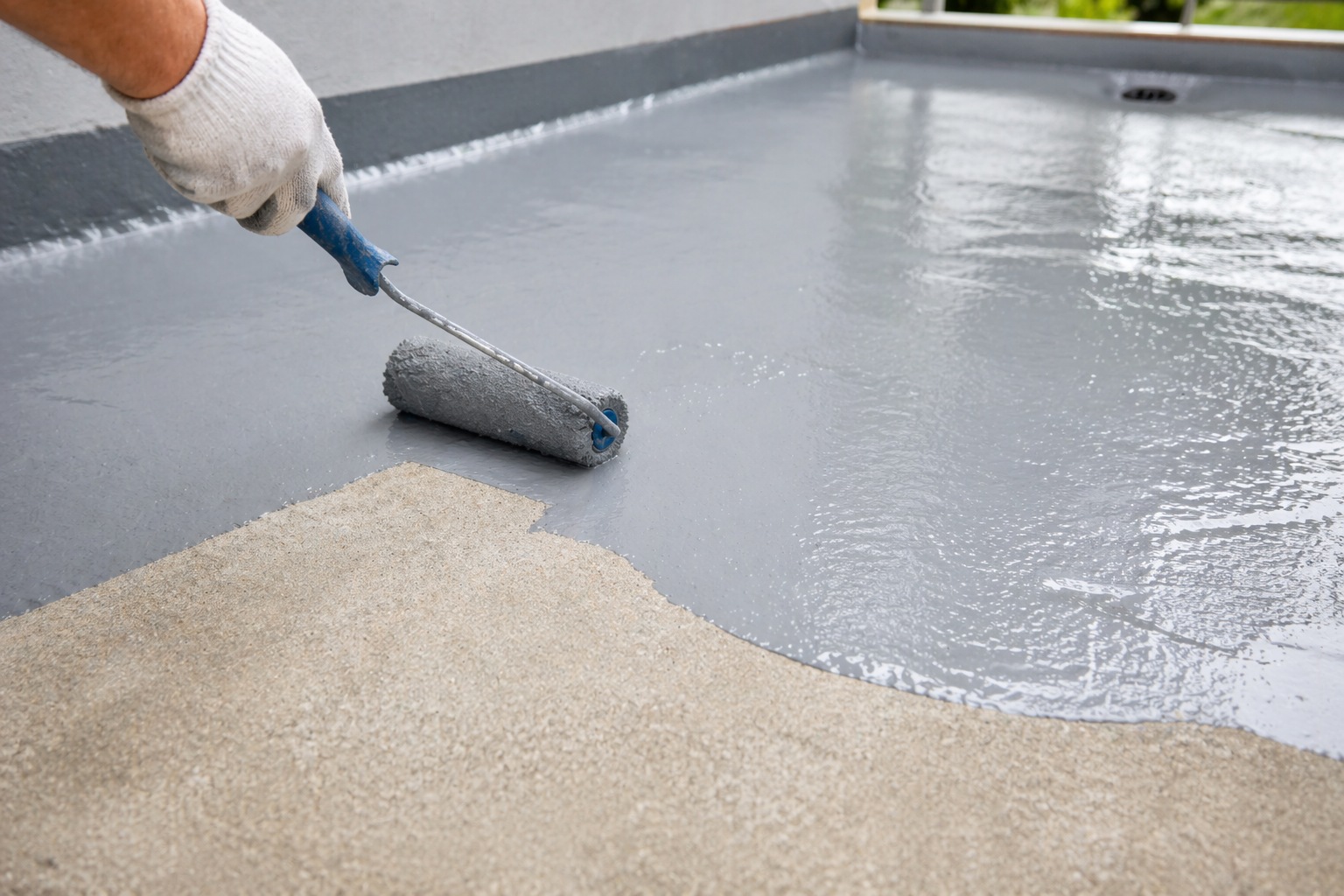
A liquid applied membrane starts as a fluid coating. We apply it with a brush, roller, or spray, depending on the product and the project. Once it cures, it forms a continuous waterproof layer over the deck.
This approach is popular because it can conform to all kinds of shapes and details that are harder to handle with sheet membranes. If your deck has multiple transitions, vertical flashings, unusual edges, built-in features, or tight corners, liquid applied waterproofing can be a very practical solution.
Why homeowners choose liquid applied waterproofing
We usually recommend applied waterproofing systems when a deck has a lot going on. Think:
- A rooftop deck with multiple penetrations
- Balconies with tight edge details
- Surfaces with irregular substrates
- Areas around drains and wall connections
- Projects where a seamless membrane is a major advantage
Because the membrane is continuous, there are no exposed field joints across the main deck area. That matters because seams are one of the most common points of failure in many waterproofing assemblies.
Main advantages of liquid applied membrane systems
Here are the biggest reasons we like liquid systems in the right setting:
- Seamless protection: No open field joints for water to work through
- Great for complex shapes: Easier to apply around curves, edges, corners, and penetrations
- Excellent adhesion: Can bond well to prepared concrete, wood, and plywood
- Elastic movement: Many systems are flexible enough to handle normal movement better than rigid layers
- Useful for detailed waterproofing applications: Strong fit for flashings, transitions, and vertical surfaces
When we are dealing with challenging geometry, liquid waterproofing often gives us more control.
Main drawbacks of liquid applied waterproofing
Liquid systems are not automatically better. They require care and experience.
Some of the biggest drawbacks include:
- Thickness control matters: The membrane has to be applied at the correct depth
- Installation quality matters a lot: Uneven application can create weak spots
- Weather conditions matter: Rain, moisture, humidity, and temperature can affect results
- Longer install timeline: Many products need multiple coats and cure time between steps
- May require recoating: Some systems need future maintenance sooner than sheet systems
This is why we never describe liquid systems as simple paint-on waterproofing. They look simple from a distance, but real performance depends on preparation, coverage rate, proper cure, and installer skill.
What Is Vinyl Sheet Deck Waterproofing?

Vinyl deck waterproofing uses pre-manufactured sheet membranes that are rolled over the prepared deck surface and sealed at the seams. These systems are common on balconies and elevated decks because they can function as both the waterproofing membrane and the finished walking surface.
That dual role is one reason many homeowners like them. You are not just waterproofing the structure. You are also creating the visible top layer.
Why homeowners choose vinyl sheet waterproofing
We usually see vinyl sheet systems work best on:
- Straight-edged balconies
- Standard deck layouts
- Flat or predictable surfaces
- Projects that need a finished walking surface
- Areas with frequent foot traffic
A well-installed vinyl membrane can provide reliable coverage and good wear resistance. On a clean, simple deck shape, it can be a very efficient system.
Main advantages of vinyl sheet membranes
Here is where vinyl sheet systems often stand out:
- Uniform thickness: Factory-made sheets are consistent
- Fast coverage: Often quicker to install on simple layouts
- Durable for use: Good option where the deck surface gets regular traffic
- Finished appearance: Can serve as the visible top surface
- Strong fit for standard balconies: Especially where the layout is straightforward
For the right deck, vinyl can be a very cost effective answer over the long term.
Main drawbacks of vinyl sheet waterproofing
The tradeoff is that vinyl relies on seams and detail work.
That means:
- Seams are vulnerable points: They have to be done extremely well
- Harder on complex shapes: More difficult to wrap around unusual details
- Repairs can be visible: Depending on the membrane and location
- Detailing matters: Drains, corners, posts, and transitions need precision
- Poor seam work can lead to leaks: That risk never goes away just because the product is good
When water gets in on a vinyl system, it often starts where the detailing is weakest.
Liquid Applied vs Vinyl Sheet Deck Waterproofing: Side-by-Side Comparison
Now let’s answer the question directly.
Which is better for complex shapes?
Liquid applied waterproofing is usually better for complex shapes, vertical transitions, and tricky details. Because it is fluid before it cures, it can cover edges, penetrations, corners, and custom conditions more naturally than a rigid rolled sheet.
If your deck has unusual geometry, liquid systems usually make more sense.
Which is better for flat, standard decks?
Vinyl sheet deck waterproofing is often better for flat, straight-edged layouts with fewer detailing challenges. On a standard balcony or rectangular deck, sheet membranes can be easier to install efficiently and consistently.
If the project is simple, vinyl often gains an advantage.
Which has fewer leak risks?
Liquid membranes have a big edge here because they are seamless. There are no large field seams across the deck for water to attack.
Vinyl sheet systems can still perform very well, but seam quality is everything. If the seams are weak, the system is weak.
Which handles foot traffic better?
Vinyl sheet systems are often preferred for heavy, regular foot traffic because they are designed to function as a walking surface. That makes them popular on balconies and occupied deck areas.
Liquid systems can also perform well, but the exact build matters. Some require additional wear layers or maintenance to stay in good condition.
Which lasts longer?
This depends heavily on the product, exposure, and installation quality, but in many cases vinyl sheet systems can offer a longer service life on the right project. Liquid systems may need more maintenance or reapplication sooner, especially in harsh weather conditions.
We do not like giving homeowners a one-size-fits-all number because lifespan depends on:
- Sun exposure
- Water drainage
- Traffic
- Surface prep
- Movement in the deck
- Maintenance habits
- Installation quality
A great system installed badly will still fail early.
Which is more cost effective?
The answer depends on the project.
Liquid systems may be more cost effective when the deck has lots of detail work, awkward shapes, or multiple transitions. In those cases, trying to force sheet membranes into a complex design can drive labor costs up.
Vinyl can be more efficient when the deck is flat, clean, and predictable. On simple surfaces, installation can be faster and more straightforward.
Comparison Table: Liquid Applied vs Vinyl Sheet Deck Waterproofing at a Glance
How Installation Affects Long-Term Performance
This is the part homeowners often underestimate. The membrane type matters, but the installation often matters just as much.
A waterproofing system usually fails for one of these reasons:
- Poor substrate preparation
- Incorrect membrane thickness
- Weak seam welding
- Bad detailing at drains or edges
- Trapped moisture in the deck assembly
- Application during poor humidity or bad weather
- Not enough cure time between coats
- Movement or cracking in the underlying deck
We have seen beautiful-looking decks fail because the prep was rushed. We have also seen older systems last surprisingly well because the installation was careful and complete.
That is why we always tell homeowners this:
Do not compare membranes in a vacuum. Compare the full installation plan.
Best Waterproofing Choice by Deck Type
Best for balconies
For a standard balcony with clean lines and a simple layout, vinyl sheet is often a smart choice. It handles use well and gives you a finished surface.
For balconies with unusual edges, lots of transitions, or difficult details, liquid applied membrane systems may be better.
Best for rooftop deck projects
A rooftop deck often has more complexity than it appears. There may be drains, transitions to walls, penetrations, and exposure concerns. In those situations, liquid systems can be very effective.
If the rooftop deck is large, flat, and straightforward, sheet systems may still work well.
Best for wood and plywood decks
On wood and plywood deck assemblies, we look closely at movement, layout, drainage, and traffic. Vinyl is often a familiar option here, especially when the homeowner wants the membrane to double as the walking surface.
But on detailed or non-standard assemblies, liquid systems may be the better fit.
Best for concrete surfaces
On concrete, liquid systems are often attractive because of their adhesion and ability to conform to the exact surface condition. They can also work well where the deck has unusual geometry.
That said, the actual best choice still depends on the project, not just the material.
Common Failure Points in Deck Waterproofing Systems
If you want to avoid expensive surprises, watch for these common red flags:
- Seams pulling apart
- Soft spots under the deck surface
- Standing water near drains
- Blisters or peeling in a liquid membrane
- Visible wear in high-traffic paths
- Cracks in the underlying concrete or decking
- Moldy smell or evidence of trapped moisture
- Water staining below the deck
- Loose transitions at walls or posts
These issues can lead to:
- Ongoing water damage
- Hidden rot in joists and framing
- Surface failure
- Premature membrane replacement
- More repair cost later
How to Choose the Best Choice for Your Project
When homeowners ask us which system to choose, we walk through a simple checklist.
Choose liquid applied waterproofing when:
- Your deck has complex shapes
- The substrate is irregular
- You need a seamless system
- There are many penetrations, transitions, or flashings
- You want strong adaptability in the installation
Choose vinyl sheet deck waterproofing when:
- Your deck is flat and straightforward
- You want a finished walking surface
- The layout has simple edges and fewer tricky details
- The deck gets regular foot traffic
- You want factory-made uniform membrane thickness
Ask these questions before deciding
- What is under the membrane, plywood, concrete, or something else?
- How many drains, posts, joints, and transitions are there?
- How exposed is the deck to sun, rain, and changing temperatures?
- Do you want lower upfront complexity or fewer seams?
- Are you planning for appearance, performance, or both?
- What kind of maintenance are you comfortable with over time?
Those answers matter more than marketing claims.
Final Verdict on Liquid Applied vs Vinyl Sheet Deck Waterproofing
So, liquid applied vs vinyl sheet deck waterproofing, which one is better?
Our honest answer is this:
Liquid applied waterproofing is usually better for detailed decks, irregular layouts, and areas where seamless protection matters most. Vinyl sheet waterproofing is usually better for flat, standard balconies and deck surfaces that need durable, traffic-ready coverage.
Neither option wins every time.
The best choice depends on:
- The shape of the entire deck
- The type of substrate
- The amount of foot traffic
- Exposure to weather conditions
- Installation quality
- Long-term maintenance expectations
- Total project cost
If you match the membrane to the project, both systems can perform well. If you choose the wrong system for the deck, even a premium product can disappoint you fast.
Need Help Choosing the Right Deck Waterproofing System?
If you are weighing the pros and cons of liquid applied vs vinyl sheet deck waterproofing, the smartest next step is to look at your actual deck conditions, not just the product labels. We always recommend evaluating the deck shape, drainage, existing surface, structural condition, and how you plan to use the space before choosing a system.
If you are also dealing with active leaks, soft spots, or signs of moisture damage, it is worth addressing those issues before any new membrane goes down. A waterproofing product can only do its job when the assembly below it is ready for it.
At ROT Doctor, we help homeowners choose the right waterproofing approach for their deck, balcony, or rooftop project based on real site conditions, not guesswork. Whether you need help with a leaking deck, damaged substrate, or a full waterproofing replacement, our team can inspect the problem, explain your options clearly, and recommend the best solution for long-term protection.
If you are planning a deck waterproofing project, contact ROT Doctor to schedule an inspection and get expert help choosing the right system for your home.
FAQs
1. What is the main difference between liquid applied and vinyl sheet deck waterproofing?
The main difference between liquid applied vs vinyl sheet deck waterproofing is how the waterproofing membrane is installed and how it performs across the deck surface. A liquid applied membrane is rolled, brushed, or sprayed onto the substrate and cures into a seamless layer, while vinyl uses pre-manufactured sheet membranes with sealed seams. Liquid systems are often better for complex layouts and irregular details, while vinyl sheet systems are commonly used on flat, standard deck surfaces that need a durable walking finish.
2. Is liquid applied waterproofing better for complex shapes?
Yes, liquid applied waterproofing is usually the better choice for complex shapes, penetrations, vertical transitions, and irregular substrates. Because the membrane is applied in liquid form, it can conform more easily to unusual edges, drains, joints, and detailing that can be harder to cover with sheet waterproofing membranes. That seamless coverage can also reduce the number of vulnerable areas where water may penetrate.
3. Is vinyl sheet better for high foot traffic?
In many cases, yes. Vinyl sheet deck waterproofing is often a strong option for decks, balconies, and rooftop surfaces that get regular foot traffic because it can serve as both the waterproofing layer and the finished walking surface. When properly installed, vinyl sheet systems offer uniform coverage and good wear resistance, especially on simple, straight-edged deck layouts.
4. Which system lasts longer: liquid applied or vinyl sheet deck waterproofing?
The lifespan of liquid applied vs vinyl sheet deck waterproofing depends on installation quality, maintenance, traffic, weather exposure, and the condition of the underlying substrate. Vinyl sheet membranes can last a long time on the right project, especially when seams stay intact and the deck surface is properly maintained. Liquid applied membranes can also perform well, but they may need recoating sooner in some environments, particularly when exposed to heavy wear or harsh weather conditions.
5. Which waterproofing option is more cost effective?
The most cost effective option depends on the shape of the deck and the complexity of the installation. A liquid applied membrane can be more cost effective on decks with multiple details, odd angles, penetrations, or irregular surfaces because it is easier to apply around those conditions. Vinyl sheet deck waterproofing can be more efficient on large, flat, straightforward decks where the installation is simpler and faster.
6. Are seams the weakest part of sheet membranes?
Seams are often the most sensitive part of sheet membranes because they are the points where separate sections of material are joined together. If the seams are not heat welded or detailed correctly, water can get through and cause leaks, water damage, and deterioration below the surface. That is why seam quality is one of the biggest performance factors in vinyl sheet deck waterproofing systems.
7. Can liquid applied waterproofing crack or peel over time?
Yes, liquid applied waterproofing can crack, peel, or wear down over time if it is installed incorrectly, applied at inconsistent thickness, or exposed to movement, standing water, or harsh weather without proper maintenance. Problems are more likely when the substrate is poorly prepared or the membrane does not fully cure before use. A well-installed liquid applied membrane is designed to be durable, but like any waterproofing system, it still depends on good preparation and ongoing care.
8. Which is better for a rooftop deck or balcony?
For a rooftop deck or balcony, the better system depends on the layout, drainage, traffic, and detailing. Liquid applied waterproofing is often better for balconies or rooftop decks with complex shapes, drains, penetrations, and vertical transitions because it creates a seamless layer. Vinyl sheet deck waterproofing is often better for flat, standard balconies where you want a durable, finished walking surface with consistent coverage.

.svg%20fill.svg)




.svg)